Published
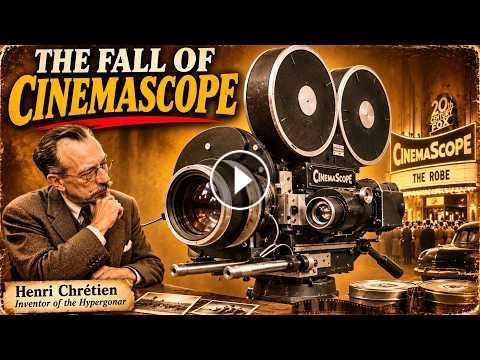
How did CinemaScope revolutionize Hollywood in 1953, save the movie theater experience from the growing threat of television, and then quietly disappear from the film industry it helped transform?
For more than a decade, CinemaScope represented the future of American cinema. Its revolutionary anamorphic lens technology turned ordinary 35mm film into spectacular widescreen images, transforming movie theaters into immersive entertainment destinations. Yet behind Hollywood's greatest optical breakthrough was a series of engineering problems that would eventually bring down the original CinemaScope system.
The story began with French inventor Henri Chrétien, whose Hypergonar anamorphic lens, developed in the 1920s, introduced an ingenious method of squeezing wide images onto conventional film. In the early 1950s, Twentieth Century Fox recognized the invention's enormous potential as television threatened theatrical attendance.
Working with optical manufacturer Bausch & Lomb, Fox transformed this forgotten technology into CinemaScope. When The Robe premiered at New York's Roxy Theater in September 1953, its extraordinary 2.55:1 widescreen presentation announced a new era in motion picture history.
Soon, Hollywood studios were investing in anamorphic lenses, upgraded projection equipment, and enormous theater screens. CinemaScope changed cinematography, movie composition, and the engineering behind theatrical exhibition.
But the original system had serious limitations.
Early CinemaScope lenses required challenging lighting conditions and suffered from optical distortion. Their most notorious defect became known as the "CinemaScope Mumps," an anamorphic focusing problem that could make actors' faces appear unnaturally wide during close-up shots.
Then came Robert Gottschalk and Panavision.
In 1958, Panavision introduced the Auto Panatar, an advanced anamorphic lens system designed to overcome the shortcomings of the original CinemaScope equipment. Its improved optical mechanics allowed cinematographers to capture widescreen images and natural-looking close-ups without the same frustrating distortions.
As Hollywood filmmakers increasingly adopted Panavision lenses, the original Bausch & Lomb CinemaScope equipment gradually disappeared from production.
By 1967, the CinemaScope name had largely vanished from new Hollywood releases, even though the widescreen filmmaking revolution it had started continued.
Today, modern anamorphic cinematography still carries the legacy of Henri Chrétien's optical invention. From classic Hollywood epics to contemporary digital filmmaking, widescreen aspect ratios, anamorphic lens flares, and distinctive cinematic compositions remain essential parts of motion picture storytelling.
This documentary explores the rise and fall of CinemaScope, the forgotten engineering behind Hollywood's widescreen revolution, the competition between CinemaScope and Panavision, and how one optical invention permanently changed the way audiences experience movies.
If you enjoy forgotten technologies, vintage film equipment, optical engineering, Hollywood history, and the inventions that transformed modern entertainment, subscribe for more documentaries about the machines and technologies that changed the world.
What do you think mattered more to Hollywood's widescreen revolution: CinemaScope's original invention or Panavision's improvements? Share your thoughts in the comments below.
#CinemaScope #FilmHistory #WidescreenCinema #Panavision #ForgottenTechnology
- Catégories
- vidéos/films
- Mots-clés
- CinemaScope, what happened to CinemaScope, CinemaScope history

Soyez le premier à commenter cette vidéo.
Up Next
Autoplay
-
00:20

Technology ଏ ଦୁନଆ ✝️???? New Trending Christian Song #timatmajhishortvideo #dance#technology#viralso
-
35:05
Chúa Thánh Thần là ai? Sự thật mà ít Kitô Hữu biết (mạc khải đầy đủ theo Kinh Thánh)
-
00:14
Chúa Jesus Đến Thế Gian Vì Yêu Nhân Loại #shorts
-
00:06
Leaders Trump and Putin are praying in front of Jesus #ai #technology #putin#trump #shorts
-
1:11:49
Thánh Lễ Chúa Nhật Lễ Lá 2/4 dành cho những người không thể đến nhà thờ
-
3:02:39
Top Sự Thật Chấn Động Về Công Giáo Sẽ Khiến Bạn Thay Đổi Cách Nhìn Mãi Mãi | Bí Mật Tạo Hoá
-
51:48
Thánh Lễ Chúa Nhật 13 Mùa Quanh Năm 02/7 dành cho những người không thể đến nhà thờ
-
1:02:45
CHẦU THÁNH THỂ 20:00 | LẦN CHUỖI LÒNG CHÚA THƯƠNG XÓT | NGÀY 1-9-2023 | NHÀ THỜ ĐỨC BÀ
-
29:24
Une actrice d'Hollywood trouve sa paix en Christ
-
00:11
Sa fait beaucoup pour Hollywood ????#diddy #hollywood #chretien #jesus #evangile
-
27:06
JOB: PELÍCULA COMPLETA | La Historia MÁS DOLOROSA y PODEROSA de FE JAMÁS CONTADA
-
03:14

Faveur Mukoko - Enfant Chérie (Clip Officiel)
-
03:29

INDIRA - Tout Sauf La Honte (Clip Officiel)
-
2:28:32

JOSHUA KPLE NAYA 1-2-3-4-5-6 [ Ibo Film Complet En Éwé 2023]
-
2:05:53

Le Pasteur et la Prostituée. FILM CHRÉTIEN
-
1:13:43

LA VOLONTÉ DE DIEU DANS LE CHOIX D'UN CONJOINT/FILM CHRÉTIENS 2023/COMPLET EN FRANÇAIS
-
11:22

UNE FEMME RICHE ACHÈTE UN SANS-ABRI
-
1:16:52

????GOD SAYS : I AM HEALING YOU TONIGHT.I WANT TO GIVE YOU $50,000,000,000 MONEY INTO YOUR BANK ACCO
-
2:04:14

JEUDI 03 OCTOBRE 2024 à Bujumbura, Fr ALBERT NUMBI KAPEMBA
-
26:51

Film ibo ewe MAWU SUBƆSUBƆDƆ 1-2 ( abonné vous que tu peux voir numéro 3-4